

Most organizations spend significant time discussing strategy — goals, priorities, culture, performance. All of those conversations matter. Yet the success of an organization rarely depends on what is discussed in the boardroom.
Success is often determined by thousands of conversations occurring throughout the organization every day — a conversation between a manager and an employee, a conversation addressing performance, a conversation navigating change, a conversation helping someone think differently.
Leadership becomes visible in those moments. Not in the strategy document. Not in the organizational chart. In the conversation.
The Leadership Gap Nobody Talks About
Many leaders genuinely want to develop people. They want to create ownership, encourage accountability, and help people think for themselves. Yet when the moment arrives, many default to one of two extremes.
The Director: The leader provides answers, offers solutions, explains what should happen, makes decisions. The conversation becomes efficient — but ownership often suffers.
The Coach: The leader asks questions, encourages reflection, explores possibilities. The conversation becomes insightful — but sometimes clarity suffers.
Neither approach is wrong. The challenge is believing leadership requires choosing one or the other. Modern leadership requires both.
The Conversation Is Where Leadership Lives
Consider the Five Leadership Shifts™. Where do they occur? Every single shift — from Directing to Developing, from Telling to Asking, from Controlling to Enabling, from Managing Work to Growing People, from Driving Results to Creating Momentum — happens in a conversation.
The shifts are not theoretical. They become real when leaders interact with people. That is why conversations matter. They are the mechanism through which leadership becomes visible.
Why Most Leadership Conversations Fall Short
Most ineffective leadership conversations fail for one of three reasons:
- Lack of Clarity: People leave uncertain about expectations
- Lack of Ownership: The leader solves the problem, the employee follows instructions
- Lack of Accountability: Actions are discussed but commitments are not confirmed
Purposeful Conversations™ was designed to address all three.
Build the Purposeful Conversations™ Capability
Purposeful Conversations™ is not a communication technique. It is not a script. It is not a coaching model. It is a leadership capability — one that enables leaders to create clarity, ownership, accountability, and action through everyday conversations.
At its core, it combines three powerful disciplines:
- Effective Feedback — Helping people understand reality
- Coaching Skills — Helping people think more effectively
- Action Planning — Helping people move forward
Together these elements create conversations that are both productive and developmental.
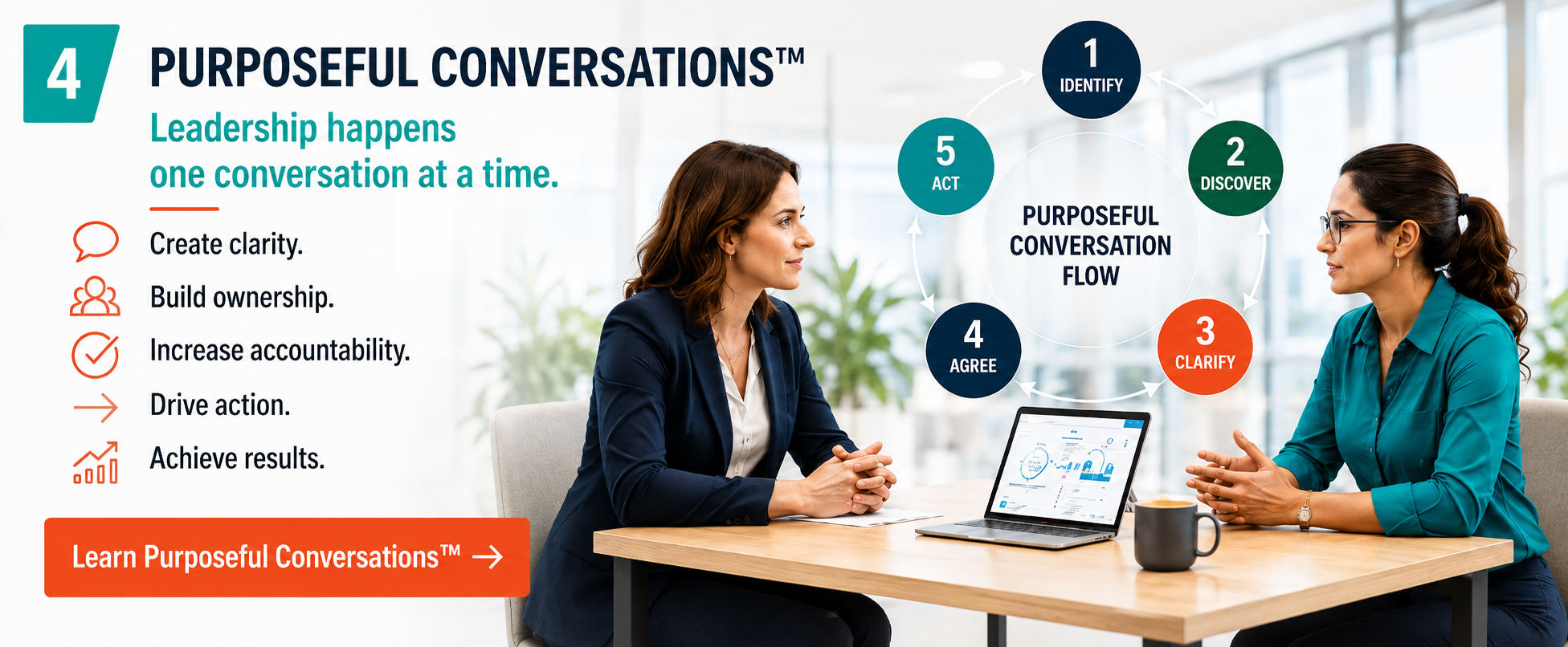
The Five-Step Conversation Framework
The conversation follows a simple progression:
- 1. Identify — What matters most? What are we really discussing?
- 2. Discover — What is happening? What perspectives exist? What assumptions are being made?
- 3. Strategize — What options exist? What possibilities should be explored?
- 4. Clear the Way — What obstacles must be addressed? What support is required?
- 5. Recap — What actions will be taken? Who owns them? What accountability exists?
This process helps conversations move beyond discussion and toward meaningful action.
Feedback That Builds Ownership
Feedback is often where leadership conversations become difficult. Many leaders avoid it. Others deliver feedback in ways that create defensiveness. Purposeful Conversations™ integrates a practical feedback process:
- State Your Intention — Create safety. Explain why the conversation matters
- Describe What You Observed — Focus on facts rather than assumptions
- Explain the Impact — Connect actions to outcomes
- Invite Reflection — Transfer ownership back to the individual. Encourage thinking, learning, and accountability
The feedback process naturally flows into the coaching process. The conversation becomes developmental rather than corrective.
The Real Outcome
The ultimate goal is not better conversations. The ultimate goal is better leaders, better teams, and better results. Purposeful Conversations™ helps leaders:
- Create clarity
- Build ownership
- Increase accountability
- Improve performance
- Develop capability
- Strengthen relationships
- Create momentum
And momentum is what closes the Pivot Gap™.
One More Capability Matters
At this point many leaders understand the conversation process. A new question emerges: How do I know when to provide direction, and when to ask questions? How do I balance managing and coaching? How do I create ownership without abandoning accountability?
That is where one of the most practical leadership skills comes into play: The Manager-Coach Dance™.
Continue the Journey
Explore The Manager-Coach Dance™ and discover how effective leaders move fluidly between telling and asking, direction and discovery, accountability and ownership.
The Manager-Coach Dance™ → View Full Framework