

Most leaders have experienced the dilemma. An employee comes to them with a problem. A project is off track. A performance issue needs attention. A difficult decision must be made. The leader faces a choice: Do I provide direction? Or do I ask questions? Do I manage? Or do I coach?
The challenge is that many leadership approaches unintentionally force leaders to choose between the two. In reality, effective leadership requires both.
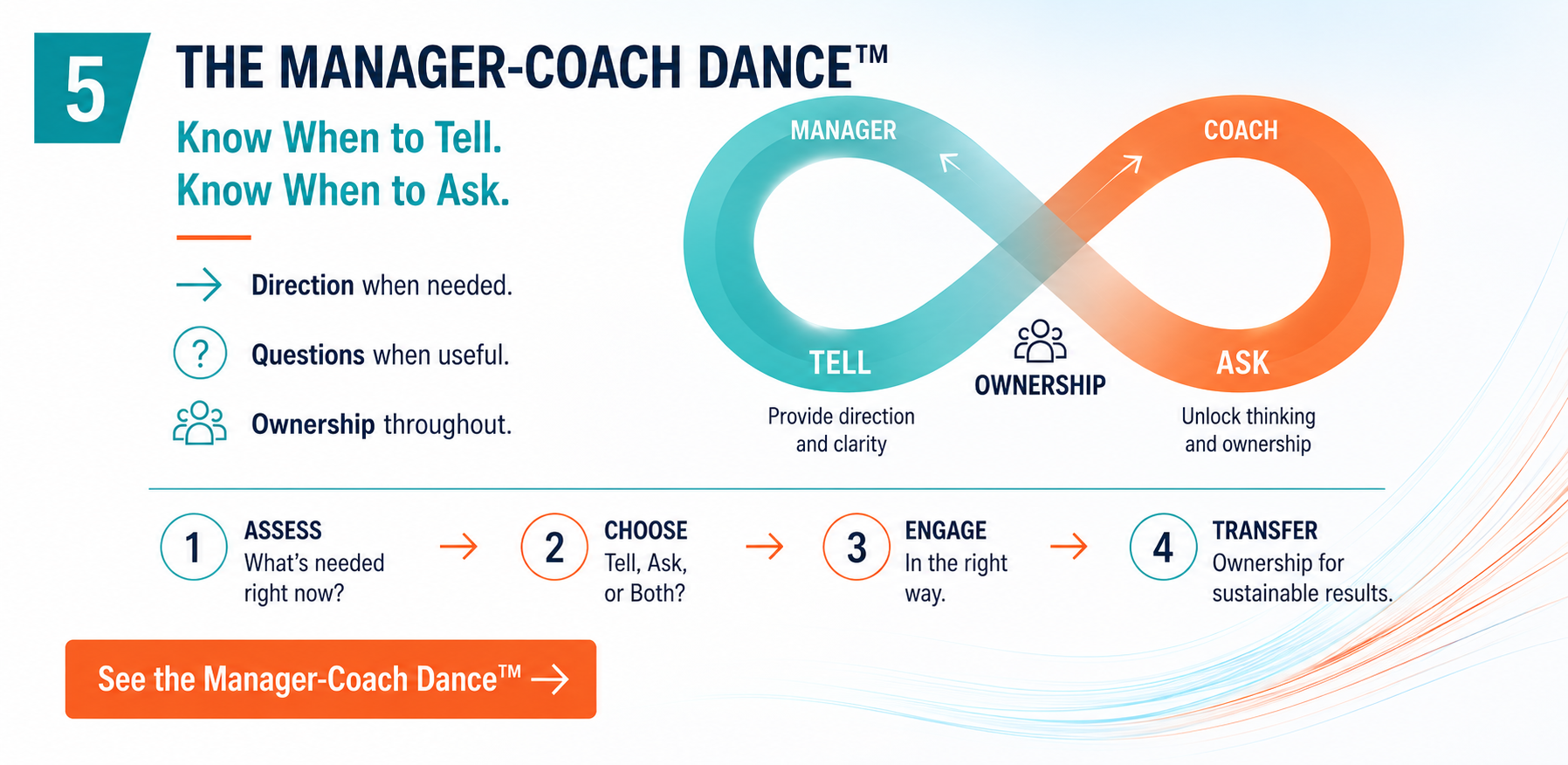
The most successful leaders know when to provide clarity. They know when to encourage discovery. They know when to guide. They know when to step back. This ability is what we call The Manager-Coach Dance™.
The Problem With Choosing Sides
Leadership conversations often drift toward one extreme. The Manager provides answers, makes decisions, solves problems, gives instructions — this approach creates speed, but over time it can also create dependence. People stop thinking. People wait for answers. Ownership decreases. The leader becomes the bottleneck.
The Coach asks questions, encourages reflection, explores possibilities, stimulates learning — this approach creates ownership, but over time it can also create frustration. People sometimes need information, feedback, and direction. Questions alone are not always enough.
The most effective leaders avoid both extremes. They learn to move between them.
Leadership Is a Dance
Imagine two dancers moving together. Neither person leads every moment. Neither person follows every moment. The movement changes based on what the situation requires. Leadership works much the same way.
Some moments require direction. Other moments require curiosity. Some moments require feedback. Other moments require reflection. The conversation moves naturally between telling and asking, managing and coaching, guiding and facilitating. That movement is the Manager-Coach Dance™.
When Leaders Should Tell
There are times when leadership requires clarity. Examples include:
- Safety concerns
- Compliance requirements
- Legal obligations
- Organizational policy
- Technical standards
- Time-sensitive decisions
In these situations people need information, expectations, and direction. Good leaders provide it.
Avoiding direction when direction is needed is not coaching. It is abdication.
When Leaders Should Ask
There are also times when leaders benefit from stepping back. Examples include:
- Problem solving
- Decision making
- Development
- Innovation
- Building ownership
- Accountability
Questions help people think, learn, reflect, evaluate, discover, and commit. The goal is not to withhold expertise. The goal is to create thinking. Because thinking creates ownership.
Ownership Is the Goal
This may be the most important principle in the entire framework. The purpose of coaching is not questions — the purpose of coaching is ownership. The purpose of feedback is not correction — the purpose of feedback is growth. The purpose of leadership is not compliance — the purpose of leadership is capability.
When people own the solution: commitment increases, follow-through improves, learning accelerates, confidence grows, momentum develops.
What the Dance Looks Like
Imagine a leader speaking with an employee whose project is behind schedule. The leader begins with feedback: "I'd like to discuss something I've noticed." The leader shares observations. The impact is discussed. Then the leader shifts: "What do you think is contributing to the delay?"
The employee reflects. Options are explored. Ideas emerge. The leader provides additional information. Questions continue. An action plan develops. Commitments are confirmed. The conversation has moved naturally between feedback, coaching, direction, reflection, and accountability. The employee leaves with ownership. The leader leaves with confidence. The work moves forward.
That is the Manager-Coach Dance™.
Why This Matters Now
The ability to balance telling and asking has become increasingly important. The pace of change requires people to think more effectively. Organizations need greater adaptability. Leaders need stronger ownership throughout their teams. Employees want opportunities to contribute.
The old model of leadership as answer-provider is becoming less effective. Today's leaders must become facilitators of thinking while still providing clarity and accountability. The Manager-Coach Dance™ helps leaders do exactly that.
Continue the Journey
Explore The Coach Partner™ and discover how leaders accelerate capability, confidence, and performance while navigating unfamiliar territory.
The Coach Partner™ → View Full Framework