

For years, organizations have worried about talent shortages. The conversation sounds familiar. "We can't find the people we need." "There aren't enough qualified leaders." "We're struggling to fill critical positions."
While these concerns are real, many organizations are misdiagnosing the problem. The challenge is often not a lack of talent. The challenge is something else.
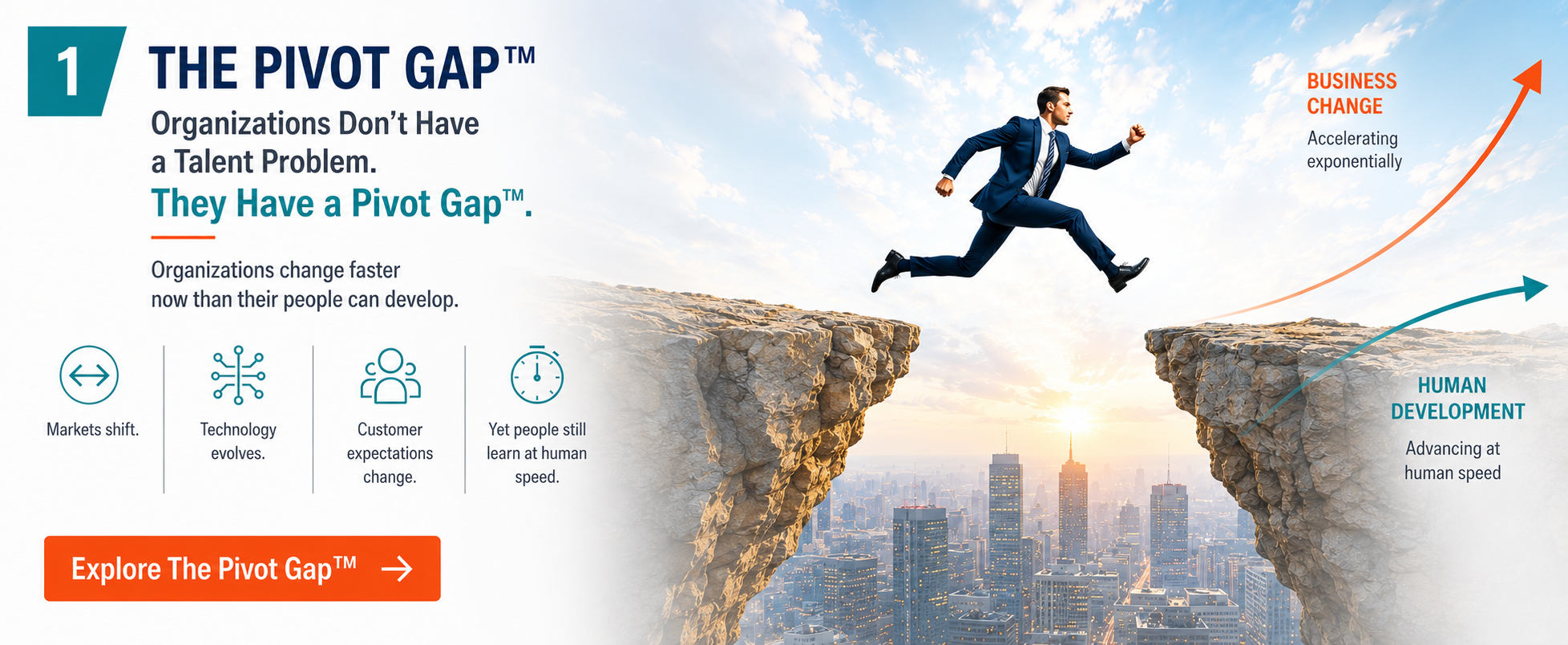
Organizations are changing faster than people can develop.
I call this the Pivot Gap™.
The World Changed
Not long ago, many organizations could create strategic plans with horizons measured in years. Five-year plans were common. Ten-year plans were not unusual. Markets evolved more gradually. Technology moved more slowly. Leadership development had time to work.
Organizations could identify high-potential employees and methodically prepare them for future roles. The environment allowed capability to develop at a pace that matched organizational change.
Today that reality has largely disappeared. Customer expectations shift overnight. Artificial intelligence transforms entire job categories. New competitors emerge unexpectedly. Regulations change. Supply chains are disrupted. Business models evolve. Organizations are being asked to pivot continuously.
The speed of change has accelerated. Human development has not.
People Still Learn at Human Speed
This is not a criticism. It is simply reality.
Experience still takes time. Judgment still takes time. Confidence still takes time. Leadership capability still takes time.
A leader stepping into a significantly larger role does not instantly acquire the experience associated with that role. A manager leading through a major transformation does not suddenly become comfortable with uncertainty. A high-potential employee promoted into senior leadership still needs opportunities to learn, reflect, and adapt.
Organizations can announce a change overnight. People cannot fully develop overnight. The distance between those two realities is the Pivot Gap™.
Why Hiring Alone Doesn't Solve It
When organizations experience capability gaps, the instinct is often to hire. Sometimes that is exactly the right answer. Many times it is not.
Organizations frequently possess talented people who are fully capable of succeeding. What they lack is support during the transition. The challenge is not finding better people. The challenge is helping capable people become effective more quickly.
Hiring addresses talent shortages. Development addresses capability gaps. The Pivot Gap™ is primarily a capability challenge.
The Hidden Cost of the Pivot Gap™
When the gap grows, organizations experience symptoms that often appear unrelated:
- Leaders become overwhelmed
- Decision-making slows
- Confidence decreases
- Stress increases
- Execution suffers
- Change initiatives stall
- High-potential talent becomes frustrated
- Organizations become more dependent on external hiring
The result is often a cycle of reacting rather than adapting. Leaders work harder. Teams feel greater pressure. The organization still struggles to move at the required speed. The problem is not effort. The problem is capability lagging behind change.
Leadership Must Change
Historically, leadership often meant having the answers. Leaders directed. Teams executed. Today's environment demands something different.
The people closest to the work frequently possess the deepest expertise. The role of leadership is evolving. Leaders are becoming less responsible for having every answer and more responsible for helping others think, learn, adapt, and perform.
The most effective leaders create momentum. They create conditions where people can contribute, grow, and succeed. That shift requires a different approach to leadership development.
Why Traditional Development Is Struggling
Traditional leadership development remains valuable. Coaching. Training. Mentoring. Succession planning. Leadership academies. These approaches continue to play an important role.
The challenge is speed. Many development systems were designed for a world that changed more slowly. Organizations now need leaders who can become effective while navigating uncertainty. Learning can no longer occur only before the challenge. Learning must occur during the challenge. Capability must develop while work is happening.
Closing the Pivot Gap™
The organizations that thrive in the coming years will not necessarily be those with the most resources. They will be the organizations that help people adapt most effectively. That requires:
- Leaders who create momentum
- Conversations that build ownership
- Capabilities that accelerate learning
- Development that occurs in real time
- Support that helps people succeed in unfamiliar territory
In short, it requires a complete leadership response.
A Different Question
Perhaps the most important question facing organizations today is not: "How do we find better talent?"
A more useful question may be: "How do we help capable people become effective faster?"
The answer to that question may determine which organizations successfully navigate the years ahead. And it begins by recognizing the challenge.
Organizations don't have a talent problem. They have a Pivot Gap™.
Continue the Journey
Explore The Merry-Go-Round Leadership Metaphor™ and discover how today's most effective leaders create momentum by helping others succeed.
The Leader Isn't On The Wheel™ → View Full Framework